What stops someone just asking an AI?
A fair amount — and not everything. This page names exactly which measures ship, what each one buys you, and where the honest ceiling is.
These are deterrents. None of them prevents cheating.
You cannot make a question unreadable to a phone camera and a vision model while keeping it readable to the person sitting the exam. So we do not aim at prevention. We aim at making one photograph useless and closing the cheap digital shortcuts — then we record what happened and give it to a human reviewer.
Three layers, each doing one job
No single control is worth much on its own. Together they raise the cost of every shortcut that does not involve a second person in the room.
Make a leaked paper worthless
Per-attempt question sets
Every attempt draws its own paper from the quiz, spread across its sections. Two people sitting the same quiz do not see the same questions — so a paper passed to the next person is one person's paper, not the exam.
Stable option shuffle
Answer choices are shuffled per attempt and then held fixed for that attempt, so a resumed exam still lines up. The effect: "the answer is B" carries no information to anybody else.
Make the screen expensive to capture
Hover-to-reveal masking
The question and each option are masked by default. Exactly one block is legible at a time. A screenshot captures one block, not a whole question.
One block at a time
A block is legible only while the pointer is hovering it. Reading a question means walking the pointer down it, block by block.
One question at a time
The paper is fetched question by question, so the full exam is never held in the browser at once. Someone inspecting the page gets the question they are on.
Close the digital shortcuts
Encrypted question delivery
Questions can be delivered as AES-256-GCM ciphertext under a key minted for that single attempt, so copying the network response yields ciphertext rather than question text. This raises the cost of scripted scraping — nothing more.
Correct answers never leave the server
The correct answer is never sent to the exam device, at any point, in any form. This is the one genuine control on this page — everything else here is friction, and we would rather draw that line ourselves.
Copy and inspection friction
Right-click, the developer-tools and view-source shortcuts, and selecting or copying question text are all suppressed. It stops the reflex, silently. It stops nothing determined, and we do not record it against anyone.
Hover-to-reveal, in detail
Everything in the question body — the stem and every option — starts masked. Moving the pointer over a block reveals that block, and only that block. Move away and it re-masks immediately.
Why one block at a time? Because the screen never holds a whole legible question, the obvious capture — one screenshot, one phone photo — comes back with a fragment. Getting the full question means going back for every block separately, which is the cost we are actually trying to impose.
It is always on — there is no setting, no plan tier, and no policy switch. Every exam, every attempt.
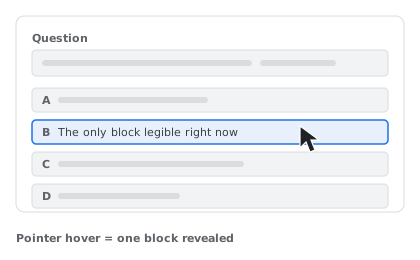
What it does not do. Someone can take five screenshots instead of one, record the screen, or point a phone at it on a tripod. Hover-to-reveal defeats none of those. It is friction against the casual screenshot-to-AI path, and we will not describe it as more than that.
The one signal a tampered exam client cannot touch
Every measure above runs on the participant's own machine — a machine they control. Someone with enough skill and motivation can interfere with any of it, and an honest page has to say so.
Answer-timing analytics are different. They are computed entirely on our servers from answers already stored, so they need nothing from the exam client and survive a client that has been modified to report an all-clear. For a multiple-choice exam this is the strongest AI-assistance signal available, and it is the one that cannot be faked from the exam device.
It is measured across the attempt as a whole, and it is a review input for a person — never a verdict. We do not publish a risk score or an "AI likelihood" number, because compressing signals of very different reliability into one authoritative-looking figure would misrepresent what the evidence supports.
What none of this can do
The same section you will find on our proctoring page, applied to AI specifically. Most vendors will not write it. We would rather you know now than discover it during a dispute.
A phone reads what a person reads
Any content legible to the participant is legible to a camera beside them and the model behind it. This is true in principle, not a gap we intend to close.
A second device or a helper is invisible
Software running on the exam machine cannot see a second laptop, a phone, or another person in the room. Camera framing is the only partial mitigation.
Encryption is not a security control
The browser must hold the key to display the question, so whoever can read the plaintext can read the key. It costs a scraper real work; against a determined individual it buys nothing, and we do not count it as protection.
Nothing here blocks an attempt
Not one of these measures can end someone's exam, and that is deliberate. The reviewer is the enforcement mechanism — see Proctoring.
Hover-to-reveal needs a mouse
The reveal gesture accepts a mouse or a pen only. There is no touch path, no keyboard path, and no screen-reader path. That is a deliberate design decision, and it has a real consequence we would rather you hear from us.
Touch-only devices cannot be used to sit an exam. Tablets and phones are stopped during the pre-check — before the timer starts, never mid-exam — so nobody loses an attempt to it. If your participants will be on tablets, or you need a screen-reader accommodation, please talk to us before you commit.